Artificial Intelligence (AI) is reshaping education, the workforce, and society as a whole. As AI-powered tools become more integrated into everyday life, higher education institutions have a responsibility to equip students and faculty with AI literacy—an essential skill set for understanding, evaluating, and ethically using AI.
The Digital Education Council (DEC) has introduced a comprehensive framework to guide institutions in fostering AI literacy. This article explores the key dimensions of the framework, its significance in modern education, and how institutions can incorporate AI education effectively.
Why AI Literacy Matters in Higher Education
AI literacy is no longer just about understanding algorithms or programming; it’s about developing a well-rounded approach to AI that includes technical knowledge, critical thinking, ethical awareness, and creativity. Students today will graduate into a world where AI influences nearly every industry. Without proper AI literacy, they risk misusing AI tools, misunderstanding their capabilities, or being unprepared for the AI-driven job market.
Higher education plays a critical role in ensuring that AI is used responsibly, ethically, and effectively across all fields—whether in medicine, law, business, engineering, or the arts. The DEC’s AI literacy framework provides a structured way for institutions to prepare students for these challenges.
The 5 Key Dimensions of AI Literacy
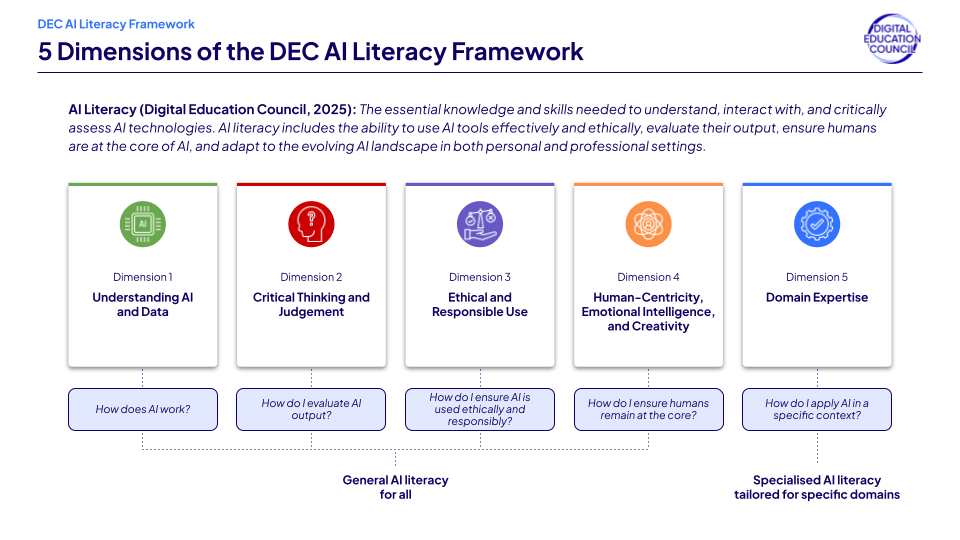
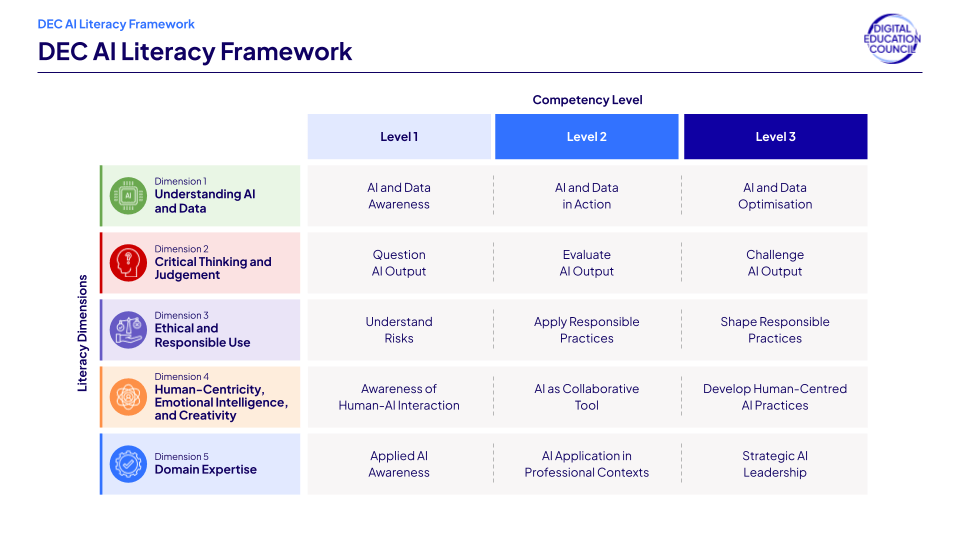
Rather than treating AI literacy as a single skill, the DEC framework breaks it down into five key dimensions that students and educators can develop over time:
1. Understanding AI and Data
- Recognizing how AI systems work, from data collection to machine learning processes.
- Learning how AI-generated content is created and how to verify its accuracy.
- Understanding the strengths and weaknesses of AI-powered decision-making.
2. Critical Thinking & Judgment
- Identifying biases in AI algorithms and outputs.
- Developing the ability to assess AI-generated content critically.
- Applying logical reasoning to AI-assisted decision-making.
3. Ethical & Responsible AI Use
- Understanding key ethical considerations such as fairness, privacy, and transparency.
- Learning how to comply with AI-related regulations and ethical guidelines.
- Evaluating the social impact of AI applications.
4. Human Skills & Creativity
- Enhancing emotional intelligence, communication, and adaptability to complement AI-driven processes.
- Understanding how AI can support creativity rather than replace it.
- Finding innovative ways to integrate AI into human-centered work.
5. Domain Expertise
- Applying AI knowledge within a specific discipline, from healthcare to business to the arts.
- Considering industry-specific implications of AI applications.
- Ensuring that AI is used in ways that align with professional standards and ethical considerations.
How Higher Education Institutions Can Implement AI Literacy
The DEC framework provides a roadmap for integrating AI literacy into curricula, ensuring that students gain both technical and ethical AI knowledge. Here’s how institutions can begin incorporating AI literacy into their programs:
1. Embedding AI Education Across Disciplines
AI education shouldn’t be limited to computer science courses. Institutions should integrate AI literacy into diverse disciplines, helping students understand how AI applies to their specific fields.
2. Teaching AI Ethics Alongside Technical Skills
While learning how to use AI tools is important, students must also understand AI ethics, bias, and responsible use. Institutions should prioritize courses and discussions on AI fairness, accountability, and transparency.
3. Encouraging Hands-On AI Learning
Giving students opportunities to experiment with AI tools—whether through projects, case studies, or interactive platforms—ensures they can apply AI knowledge practically.
4. Providing Faculty Training on AI Literacy
Faculty members need AI literacy training to effectively guide students. Institutions should invest in workshops, resources, and professional development programs focused on AI education.
5. Partnering with Industry to Bridge the AI Skills Gap
Collaboration with AI-driven companies and organizations can provide students with real-world insights, mentorship opportunities, and exposure to AI applications in their chosen fields.
Preparing Students for an AI-Driven Future
AI literacy is no longer optional—it’s a necessity. As AI continues to evolve, higher education institutions must ensure that students graduate with both technical expertise and critical awareness of AI’s impact.
The DEC’s AI literacy framework offers a structured, ethical, and interdisciplinary approach to AI education. By adopting this framework, institutions can empower students and faculty to navigate the AI-driven world responsibly and innovatively.
Higher education is uniquely positioned to shape how AI is understood and applied in the real world.
Faculty and Staff Build Custom GPTs in AI Workshop
Boise State University recently hosted a ChatGPT Hackathon, bringing together over 50 faculty and staff for a hands-on AI workshop. Held at Albertson’s Library, the event provided participants with the tools and guidance to create custom AI models tailored to their professional and educational needs.
Empowering Educators with AI
The workshop featured expert speakers from various university departments who shared insights on AI theory, policy, and applications. Attendees gained a deeper understanding of how AI can be ethically and effectively integrated into their work.
Innovative AI Solutions
During the event, participants developed over 40 unique GPT models, including:
- Accessibility Evaluators – AI tools designed to assess and improve digital accessibility for students and staff.
- Career Mentors – Virtual assistants offering personalized career guidance and professional development resources.
- Educational Enhancers – AI-driven models aimed at streamlining administrative tasks and enriching student learning experiences.
A Future of AI-Powered Innovation
The ChatGPT Hackathon demonstrated the transformative potential of AI in higher education, sparking enthusiasm for future AI initiatives. Faculty and staff left the workshop equipped with practical AI tools and inspired to explore new ways AI can enhance learning, improve efficiency, and support students.
As Boise State continues to explore AI-driven education, events like this pave the way for an AI-empowered future in academia.
Artificial intelligence is transforming the way we learn, work, and collaborate. Whether you’re an educator, student, or professional, these AI-powered tools can enhance productivity and streamline tasks. Here are some noteworthy AI tools worth exploring:
1. Thea – AI-Powered Study Assistant
What it does: Instantly generates practice questions and study materials for any subject, making learning more interactive and efficient.
Best for: Students, educators, and lifelong learners who want customized study resources on demand.
2. Zapier MCP – AI Meets Automation
What it does: Connects AI assistants to 7,000+ apps, enabling automated workflows and task execution.
Best for: Professionals and businesses looking to integrate AI into their workflows to increase efficiency and reduce manual work.
3. MeetGeek – AI-Powered Meeting Assistant
What it does: Records, transcribes, and summarizes meetings, providing key insights and automatically sending them to your favorite productivity tools.
Best for: Teams, managers, and remote workers who need organized meeting notes without the hassle of manual transcription.
These tools showcase the power of AI in simplifying tasks and enhancing productivity across different domains. Try them out and experience the future of AI-driven efficiency!
 APPVERSITY
Leave a comment